
How Much Does a Metal Roof Cost in 2026? Price per Square Foot
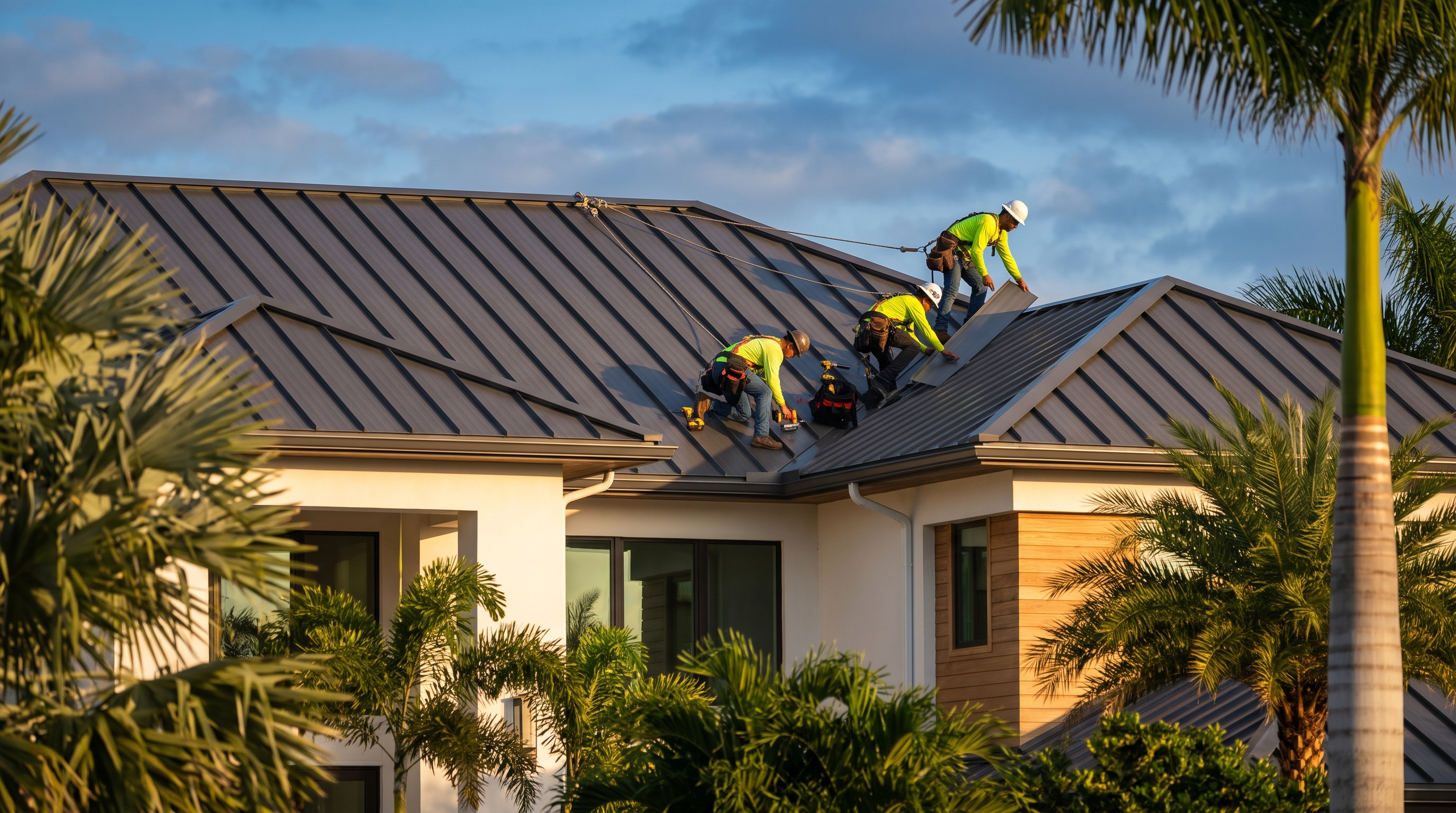
In Southwest Florida, residential metal roofing costs between $8.50 and $18.50 per square foot fully installed. For an average 2,200-square-foot single-family home in Bonita Springs or Naples, total replacement costs typically range from $22,000 to $42,000, depending on the metal profile, material gauge, and roof pitch complexity.
When homeowners ask how much does metal roofing cost, the broad ranges published on national home improvement sites often mislead them. A metal roof quoted in Georgia or Ohio does not face the Florida Building Code's 160 mph wind uplift standards, nor does it require marine-grade aluminum fasteners or high-temperature self-adhered secondary water barriers.
Below is an itemized breakdown of what metal roofing actually costs across Lee and Collier counties in 2026, comparing material types, metal gauges, and total house square footages.
Quick Verdict: Price Ranges for 2026
Budget approximately $8.50 to $11.50 per square foot for exposed-fastener 5V-crimp Galvalume panels, and $12.00 to $18.50 per square foot for concealed-fastener standing seam systems. Near salt water bays or west of US-41 in Bonita Springs, upgrading to coastal-grade aluminum runs $14.00 to $19.50 per square foot to guarantee zero red rust.
Metal Roofing Cost per Square Foot by Material Type
The price of metal depends primarily on the fabrication style and alloy. Sheet metal panels fall into two distinct installation categories: exposed-fastener panels and concealed-clip standing seam systems.
Exposed-fastener systems (like 5V-crimp or corrugated steel) use thousands of neoprene-gasketed screws driven through the top of the panels directly into the deck. They cost substantially less to manufacture and install, but the rubber washers require replacement every eight to ten years.
Concealed-fastener standing seam systems use vertical panels with raised interlocking ribs. Stainless steel clips lock the panels beneath the seams, eliminating exterior screw penetrations completely. Our professional metal roofing services focus on standing seam systems because they deliver the wind performance and water resistance required by coastal hurricane zones.
| Metal Roofing System | Material & Finish | Cost per Sq Ft Installed | Typical 2,200 Sq Ft Roof | Expected Lifespan in SWFL |
|---|---|---|---|---|
| 5V-Crimp (Exposed Screws) | 26-gauge Galvalume steel | $8.50 – $11.50 | $18,700 – $25,300 | 20 – 30 years |
| Standing Seam Steel | 24-gauge Galvalume with Kynar 500 | $12.00 – $16.50 | $26,400 – $36,300 | 45 – 60 years |
| Standing Seam Aluminum | 0.032" / 0.040" Marine-grade Aluminum | $14.00 – $19.50 | $30,800 – $42,900 | 50 – 70+ years |
| Stone-Coated Steel Shingles | 26-gauge stamped steel tile/shake | $11.50 – $15.50 | $25,300 – $34,100 | 35 – 50 years |
| Architectural Copper | 16 oz / 20 oz Cold-rolled copper | $25.00 – $42.00 | $55,000 – $92,400 | 100+ years |
Metal Roof Cost Estimates by Home Size
Roof square footage always exceeds a home's interior living area due to roof slope, overhangs, covered lanais, and garage space. A 2,000-square-foot ranch home with standard two-foot eaves and a 5:12 pitch typically translates to roughly 2,400 to 2,600 square feet of actual roof surface (or 24 to 26 roofing squares).
The table below outlines realistic installed cost ranges across common home footprints in Southwest Florida:
| Home Living Area | Estimated Roof Surface | 5V-Crimp Steel (Budget) | Standing Seam Steel (Standard) | Standing Seam Aluminum (Coastal) |
|---|---|---|---|---|
| 1,500 sq ft home | ~1,850 sq ft | $15,700 – $21,200 | $22,200 – $30,500 | $25,900 – $36,000 |
| 2,000 sq ft home | ~2,450 sq ft | $20,800 – $28,100 | $29,400 – $40,400 | $34,300 – $47,700 |
| 2,500 sq ft home | ~3,100 sq ft | $26,300 – $35,600 | $37,200 – $51,100 | $43,400 – $60,400 |
| 3,200 sq ft home | ~4,000 sq ft | $34,000 – $46,000 | $48,000 – $66,000 | $56,000 – $78,000 |
What Gauge Is Metal Roofing? Thicknesses and Durability Explained
When evaluating contractor bids, homeowners often encounter varying gauge numbers and wonder what gauge is metal roofing and how it impacts long-term survival.
In metal manufacturing, gauge numbers run backward: the lower the gauge number, the thicker and heavier the metal.
- 29-Gauge Metal: Measuring approximately 0.014 inches thick, 29-gauge steel is thin, lightweight material primarily intended for agricultural pole barns, carports, and utility sheds. We do not recommend 29-gauge metal for residential homes in Southwest Florida because the thin steel can tear around fastener heads during tropical storms and easily dents from minor tree branch impacts.
- 26-Gauge Metal: Measuring roughly 0.018 inches thick, this is the most common entry-level residential metal. Homeowners frequently ask is 26 gauge metal roofing good for a Florida house. For exposed-fastener 5V-crimp installations on moderate roof slopes, 26-gauge Galvalume provides adequate performance at an accessible price. However, on long standing seam panels, 26-gauge steel is prone to "oil-canning" (visible cosmetic waviness caused by thermal expansion under the Florida sun).
- 24-Gauge Metal: Measuring roughly 0.024 inches thick, 24-gauge steel is the commercial-grade gold standard for residential standing seam. It has the tensile rigidity needed to prevent oil-canning, holds tight structural clips under 160+ mph uplift forces, and easily handles heavy tropical downpours.
- Aluminum Thickness (0.032" and 0.040"): Aluminum is not measured in steel gauges; it is specified in decimals of an inch. A 0.032" aluminum panel is roughly equivalent in stiffness to 24-gauge steel, while 0.040" represents heavy-duty hurricane-rated plate. Within three miles of the Gulf of Mexico or along Bonita Springs canals, aluminum is superior to steel because salt spray cannot cause galvanic red rust.
Additional Factors That Drive the Total Invoice
When estimating how much is metal roofing for your specific home, the panels themselves represent roughly 35% to 45% of the total contractor proposal. The remaining balance covers code-mandated preparatory work, structural upgrades, and specialized labor.
Old Roof Tear-Off and Disposal
Removing old shingles costs between $1.50 and $2.50 per square foot, including dumpster fees and landfill tipping charges. Removing an existing concrete or clay tile roof costs between $2.50 and $4.00 per square foot due to the immense physical weight of masonry tiles and mortar beds.
Plywood Sheathing Re-Nailing
The Florida Building Code requires contractors replacing a roof to verify that the plywood decking meets current wind uplift standards. Crews must install 8d ring-shank nails every six inches along all panel seams. If previous moisture leaks caused wood rot, replacing rotted 4x8 plywood sheets runs between $85 and $125 per sheet installed.
Secondary Water Resistance (SWR) Underlayment
High-temperature self-adhered membrane (commonly called peel-and-stick) is mandatory under residential metal roofs in Florida. Metal surfaces heat up past 165°F during summer afternoons; standard organic felt would melt and stick to the metal. Premium polymer-modified bitumen underlayment adds between $1.25 and $2.00 per square foot but qualifies you for substantial discounts on homeowners insurance.
Roof Complexity, Valleys, and Pitch
A simple gable roof with two flat slopes requires minimal sheet metal cutting and installs quickly. Complex hip roofs with multiple dormers, valley intersections, skylights, and steep pitches (over 6:12) require custom hand-bent flashing profiles and substantial safety staging, adding 15% to 30% to the labor cost.
Long-Term Return on Investment: Why Metal Pays for Itself
While metal carries a higher initial invoice than asphalt, it delivers financial offsets that lower the net cost over time:
- Lower Electric Bills: Reflective Kynar 500 cool-roof finishes deflect solar heat, keeping attic spaces up to 30°F cooler and reducing annual air conditioning loads by 15% to 25%.
- Insurance Discounts: Because metal roofs carry Class 4 impact ratings and Miami-Dade/Florida Product Approvals for 160+ mph winds, local carriers provide maximum mitigation credits on property insurance policies.
- Eliminating the Next Replacement Cycle: While an asphalt shingle roof in Florida demands complete replacement every 14 to 18 years, a standing seam aluminum roof lasts 50 to 70 years. Over thirty years of homeownership, avoiding a second $25,000 re-roofing project makes metal the more cost-effective choice.