
What Are the Most Durable Roofing Materials for Southwest Florida Homes?
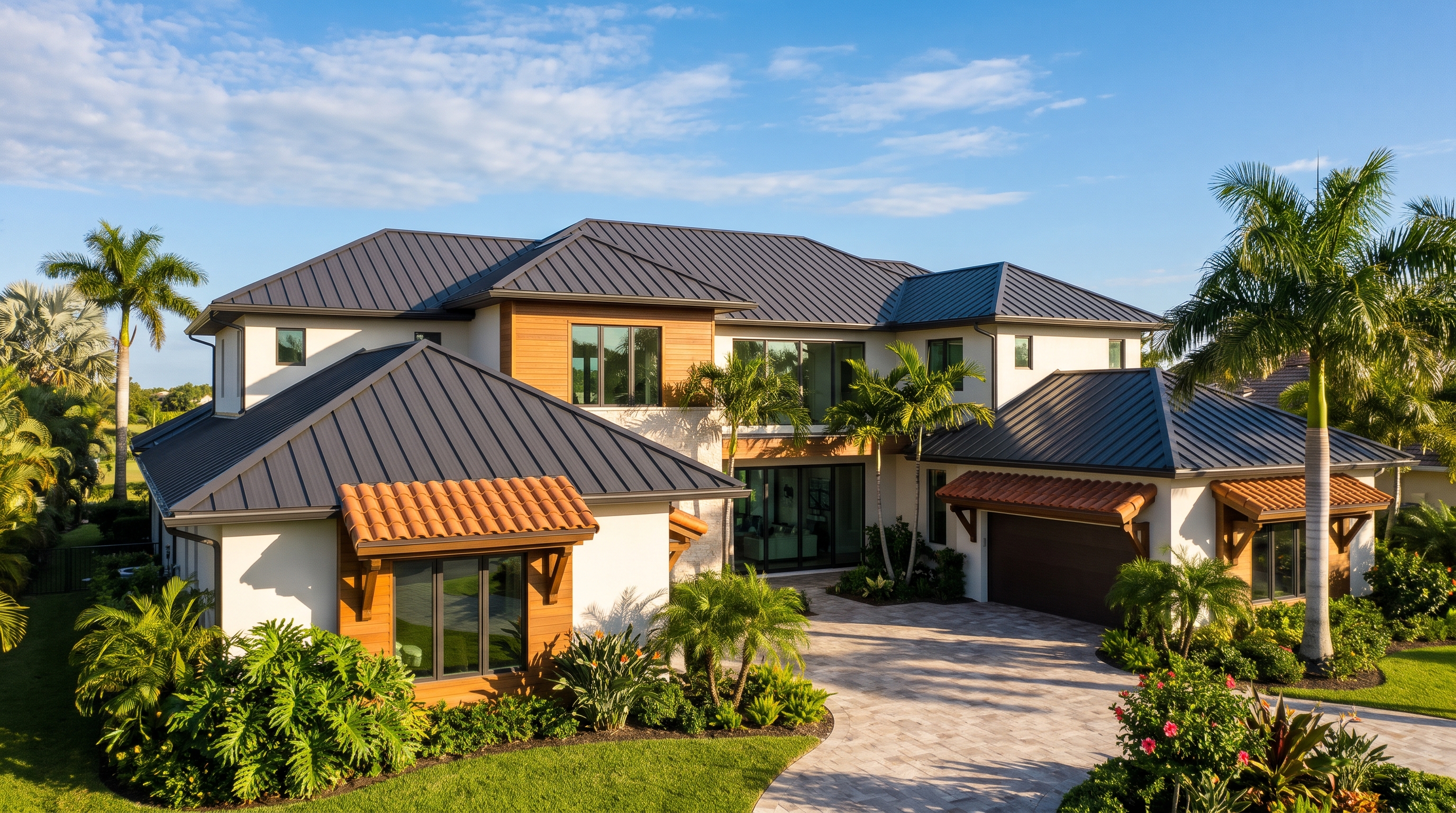
If you ask ten roofing contractors in Lee or Collier County what the most durable roof is, nine will immediately narrow the choice down to standing seam metal or concrete and clay tile.
Durability in Southwest Florida does not mean what it means in Ohio or Pennsylvania. Up north, roofs fail from winter freeze-thaw cycles and heavy snow loads. In Bonita Springs, Naples, and Fort Myers, roofs face three specific threats year-round: eight months of brutal ultraviolet radiation baking the surface past 160°F, salt-laden coastal humidity that corrodes standard fasteners, and tropical cyclones throwing 140 to 160 mph wind-driven rain against every seam.
A material that lasts 30 years in a moderate climate can easily degrade in 15 years under the Florida sun. Below is an honest comparison of how tile, metal, asphalt shingles, and flat-roof TPO actually hold up over decades in Southwest Florida.
Quick Verdict: What Roofing Material Lasts the Longest?
Clay and concrete tile hold the record for raw material longevity (50 to 100 years), but standing seam metal (aluminum or galvalume) provides the best overall durability against hurricane winds and structural water intrusion with the lowest maintenance burden over 40 to 70 years. For low-slope surfaces and lanai additions, heat-welded TPO single-ply membrane delivers 20 to 30 years of ponding water resistance where sloped materials cannot be installed.
Concrete and Clay Tile: The Classic Florida Barrier
Tile is the dominant roofing material across master-planned communities in Bonita Springs, Estero, and Naples, partly due to HOA covenants and partly because masonry handles sunlight effortlessly.
Why Tile Lasts Under the Florida Sun
Unlike petroleum-based shingles, concrete and clay do not dry out, curl, or blister from intense UV radiation. Clay tiles are fired in kilns at temperatures exceeding 1,800°F; direct sun exposure does nothing to alter their chemical structure. They also create a natural thermal barrier: the curved barrel shape creates an air gap between the tile and the roof deck, allowing hot air to vent upward rather than radiating directly into your attic.
Hurricane Performance
Tile handles steady high winds well because of its mass (weighing between 800 and 1,100 pounds per 100 square feet). Modern installations using two-component expanding foam adhesive hold up significantly better than older mechanical nail-and-mortar installations.
The primary vulnerability during a hurricane is flying debris. Tree branches or loose ridge caps from a neighboring property that strike a tile roof will shatter individual tiles. Once water gets beneath cracked tiles during a storm, the roof relies entirely on the underlayment.
The Truth About the Lifespan
While clay tiles can physically last a century, the waterproofing underlayment underneath them does not. In Florida's heat, organic felt underlayment degrades within 18 to 22 years. Premium self-adhered modified bitumen membranes stretch that to 25 to 30 years.
When the underlayment fails, you will need a tile lift and reset (or "re-tile"), where workers remove the tiles, install new underlayment and flashing, and reinstall intact tiles. Factoring in this mid-life service is essential when budgeting for tile longevity.
Standing Seam Metal: The Peak Hurricane Performer
Metal roofing has grown rapidly across coastal Florida over the past decade, especially after Hurricanes Ian and Irma demonstrated its resistance to catastrophic uplift.
Why Standing Seam Holds Up Best to Hurricanes
If your priority is storm resistance, standing seam metal is the toughest residential system available. Unlike 5V-crimp or corrugated metal panels that use thousands of exposed screws driven through neoprene washers, standing seam panels interlock with concealed clips secured beneath the ribs.
- No exposed fastener holes: Exposed rubber washers dry out and crack in Florida's heat within 8 to 10 years, creating leak paths. Standing seam eliminates this vulnerability entirely.
- Wind ratings: Interlocking 24-gauge standing seam systems regularly carry Florida Product Approvals rated for winds exceeding 160 mph, far surpassing standard code minimums.
- Uplift resistance: Continuous vertical panels running from ridge to eave distribute wind uplift forces evenly across the entire roof deck rather than concentrating pressure on individual shingles or tiles.
Aluminum vs. Steel Near the Gulf
Material selection matters near the water. Steel panels (even Galvalume-coated steel) will eventually show cut-edge rust if installed within 1,500 to 3,000 feet of saltwater bays or the Gulf of Mexico.
For properties west of US-41 or near coastal canals in Bonita Springs, 0.032" or 0.040" aluminum is the proper choice. Aluminum forms its own protective oxide layer and cannot rust, making it virtually immune to marine air degradation.
Asphalt Shingles: Budget-Friendly with a Shorter Horizon
Asphalt shingles remain common across Southwest Florida because they carry the lowest initial installation cost. However, they demand realistic expectations regarding Florida durability.
What Happens to Shingles in Florida Heat
A shingle labeled as "30-year architectural" rarely lasts 30 years in South Florida. The combination of intense ultraviolet light and attic heat boiling the underside of the deck accelerates the evaporation of the volatile petroleum oils inside the asphalt binder.
Within 12 to 15 years, the shingles lose flexibility, granular loss exposes the asphalt substrate, and shingles become brittle. Once brittle, moderate gusts can snap shingles at the sealant line.
Impact-Resistant (Class 4) Shingles
If you choose asphalt, standard 3-tab shingles should be avoided completely; they carry basic 60 to 70 mph wind ratings and fail quickly during tropical storms.
Architectural laminate shingles and Class 4 impact-resistant shingles (such as SBS-modified shingles) perform substantially better. They feature reinforced nailing strips, high-tack polymer sealants rated for 130 mph winds, and flexibility that resists tree branch impacts without fracturing. In Southwest Florida, expect 15 to 20 reliable years from a well-installed architectural shingle roof.
TPO Membrane: Durability for Flat and Low-Slope Roofs
Many Southwest Florida homes feature split-pitch designs: a steep tile or shingle main roof combined with low-slope or flat sections over rear lanais, Florida rooms, carports, or front porches. Installing shingles or tiles on roofs with a slope below 2:12 violates the Florida Building Code because water cannot shed fast enough.
For these sections, Thermoplastic Polyolefin (TPO) is the industry standard for durability.
- Heat-welded monolithic seams: TPO sheets are fused together using robotic hot-air welders. The welded seams become physically stronger than the membrane itself, eliminating glued joints that fail when standing water pools after summer downpours.
- Solar reflectance: TPO comes naturally bright white, reflecting over 80% of solar radiation. This keeps flat lanai ceilings cool and prevents premature heat degradation of the roof decking.
- Ponding water resistance: Southwest Florida summer storms drop torrential rain in short bursts. TPO remains completely waterproof even if low slope transitions hold standing water for 24 to 48 hours while draining.
Southwest Florida Roofing Durability Comparison
| Roofing Material | Real Lifespan in SWFL | Hurricane Wind Rating | Salt Air Resistance | Upfront Cost | Ideal For |
|---|---|---|---|---|---|
| Standing Seam Metal (Aluminum) | 50 – 70+ years | Up to 160 – 180 mph | Exceptional (zero rust) | High | Coastal homes, hurricane zones, modern & coastal styles |
| Concrete & Clay Tile | 50 – 75+ years (Reset at 20-25 yrs) | 130 – 150 mph | High (tiles immune; stainless fasteners) | High | Mediterranean architecture, strict HOA communities |
| Architectural Shingles (Class 4) | 15 – 20 years | Up to 130 mph | Moderate (anti-algae granules) | Economical | Budget-conscious replacements, rental properties |
| TPO Single-Ply Membrane | 20 – 30 years | Up to 140+ mph | High (inert to salt & chemicals) | Moderate | Flat roofs, lanai additions, carports, low-slope sections |
Which Roofing Material Holds Up Best to Hurricanes?
When Category 4 and 5 hurricanes make landfall in Southwest Florida, roofs fail in two distinct ways: wind uplift (the pressure drop peeling panels or shingles off the deck) and wind-driven rain penetration through failed seams.
Standing seam metal consistently holds up best to hurricane-force winds. Because the panels mechanically lock together and anchor through heavy-duty clips directly into the deck, wind has no raw edge or shingle tab to catch and peel back.
Tile also resists uplift effectively when installed with modern polyfoam adhesives, but it remains susceptible to impact fractures from flying tree limbs.
The Real Defense: Secondary Water Resistance (SWR)
Regardless of the outer material, the Florida Building Code requires a sealed roof deck. In Southwest Florida, installing a self-adhered (peel-and-stick) underlayment directly onto the plywood sheathing provides a secondary waterproof skin. Even if hurricane winds rip away outer shingles or shatter clay tiles, the self-adhered barrier stays sealed around nail shanks and keeps wind-driven rain out of your living space.
This detail also qualifies homeowners for substantial credits on the Florida Homeowners Wind Mitigation Inspection (Form OIR-B1-1802), lowering annual insurance premiums.
How to Choose the Best Material for Your Home
Selecting the right roof comes down to three practical questions:
- Does your HOA require a specific material? Many communities in Bonita Bay, Pelican Landing, and Naples require concrete or barrel tile. If your bylaws permit metal, check whether color and profile guidelines apply.
- Can your home's framing support tile? Concrete and clay add thousands of pounds of dead weight to your trusses. If your home currently has shingles, an engineer or licensed roofing contractor must confirm the roof structure can carry the load before converting to tile. Metal, by contrast, is lighter than shingles and can be installed on almost any structure without modification.
- How long do you plan to own the home? If you plan to move within five to seven years, an architectural shingle roof delivers the necessary code compliance and curb appeal at the lowest out-of-pocket investment. If you plan to keep the home for fifteen years or pass it to family, metal or tile delivers a far lower cost per year of ownership by eliminating repeat replacements.